

Certainties
Discourses on the First Decade of Wallace Brett Donham (IV)

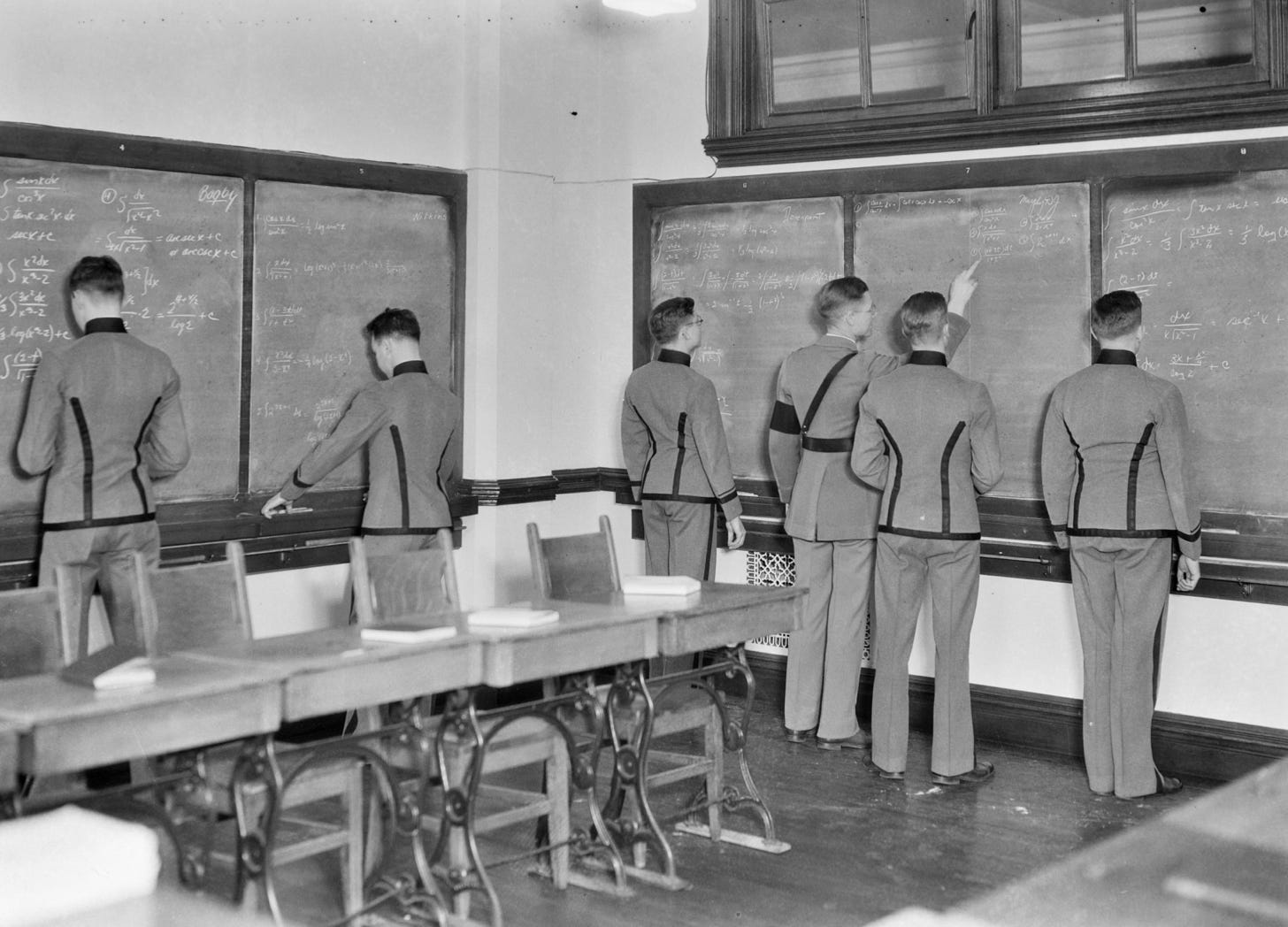
This essay belongs to a series of ‘discourses’ that build upon points made by Wallace Brett Donham in his Education for Responsible Living. As you might expect, both the title of this project and the approach that I take with the component essays owe much to the Discourses on the First Decade of Titius Livius of Niccolò Machiavelli.
I suspect that the narrow emphasis [of the V-12 program and the Army Specialized Training Program] came not because the [Armed] Services think elementary science essential as part of the training of all officers, but because they see little value for their purposes in the training through which liberal-arts colleges put men who do not specialize in science. On the other hand, they are convinced of the value of engineering training.
Most engineering-school students seem to work harder and acquire a greater sense of personal accomplishment than the general run of college students. Their work is concrete, definite, and seems to offer a satisfactory way of life. Realization of limitations, if it comes at all, usually comes later.
Even when the Services used liberal-arts colleges, these facts superficially justified emphasis on subjects appropriate in the first year of engineering schools. Yet qualities of human leadership, of trained imagination in dealing with the unexpected emergency, of elasticity of mind and of judgment, are perhaps least effectively developed, whether in the liberal-arts college or in the engineering school, by studying the certainties of elementary science and mathematics.
The critique that Dean Donham leveled upon the Army Specialized Training Program enjoyed the advantage of hindsight. That is, when, late in 1944, he handed his final draft to his publisher he knew that the war would not last as long as the designers of that schemes had feared. He also knew that most of the participants in the Army Specialized Training Program had left the program prematurely. That is, the replacement crisis of 1944 caused the Army to find new assignments for more than sixty percent of the soldiers who had been studying on college campuses. As a result, those who had studied ‘the certainties of elementary science and mathematics’ to prepare for advanced courses in engineering or the natural sciences ended up doing other things.
Donham also errs in conflating the Navy’s V-12 program with its Army counterpart. In particular, while the first thirty-two weeks of the V-12 program (which devoted 73% of academic hours to science and math) looked a lot like the first thirty-six weeks of the Army Specialized Training Program (which set aside 70% of classroom time for those subjects), most of the sailors who passed those courses went on to study navigation or engineering. In other words, while intense engagement with ‘the certainties of elementary science and mathematics’ prepared few soldiers for the challenges they would face in the last year of the war, a similar foundation fit the needs of many sailors.
Donham’s conflation of the two programs may reflect contact with the largest exception to the general rule of the V-12 program. As a professor at the Harvard Business School, he would have had some knowledge (and, I suspect, considerable contact) with the Navy Supply School located at that university. Thus, I would not be surprised if he had spoken with graduates of the V-12 course designed to prepare sailors for that school, the graduates of which earned commissions in the Navy Supply Corps. Furthermore, I can imagine conversations in which business-minded students expressed frustration at having to learn chemistry and calculus before focusing on the finer points of contracting, business law, and logistics.
In Donham’s defence, I find myself imagining an introductory curriculum for both programs that would promote ‘qualities of human leadership, of trained imagination in dealing with the unexpected emergency, of elasticity of mind and of judgment’. This, I believe, would make use of the same elements that he championed as dean of the Harvard Business School - case studies that posed problems from the point of view of particular protagonists and Socratic discussions about ways such leaders might solve the described dilemmas.
Donham, who stood at the helm of the Harvard Business School for twenty-three years, enjoyed advantages that would not have been available to the academics (both in and out of uniform) who ran the two ‘students in uniform’ programs. For one thing, while Donham was able to spend two decades building a faculty full of professors able to teach in a Socratic manner, his wartime counterparts were obliged to make do with the teachers who happened to be at hand. Likewise, the latter lacked the time, talent, and treasure that would have allowed them to obtain suitable case studies.
To be continued …
Sources
Wallace Brett Donham Education for Responsible Living (Cambridge: Harvard University Press, 1944) (Internet Archive) pages 13 and 14 (Internet Archive)
V.R. Cardozier Colleges and Universities in World War II (Westport: Praeger, 1993) pages 29-38 and 51-61 (Internet Archive)
Related Reading


