


With this essay, I continue a series of ‘discourses’ that build upon points made by Wallace Brett Donham in his Education for Responsible Living. As you might expect, both the title of this project and the approach that I take with the component essays owe much to the Discourses on the First Decade of Titius Livius of Niccolò Machiavelli.
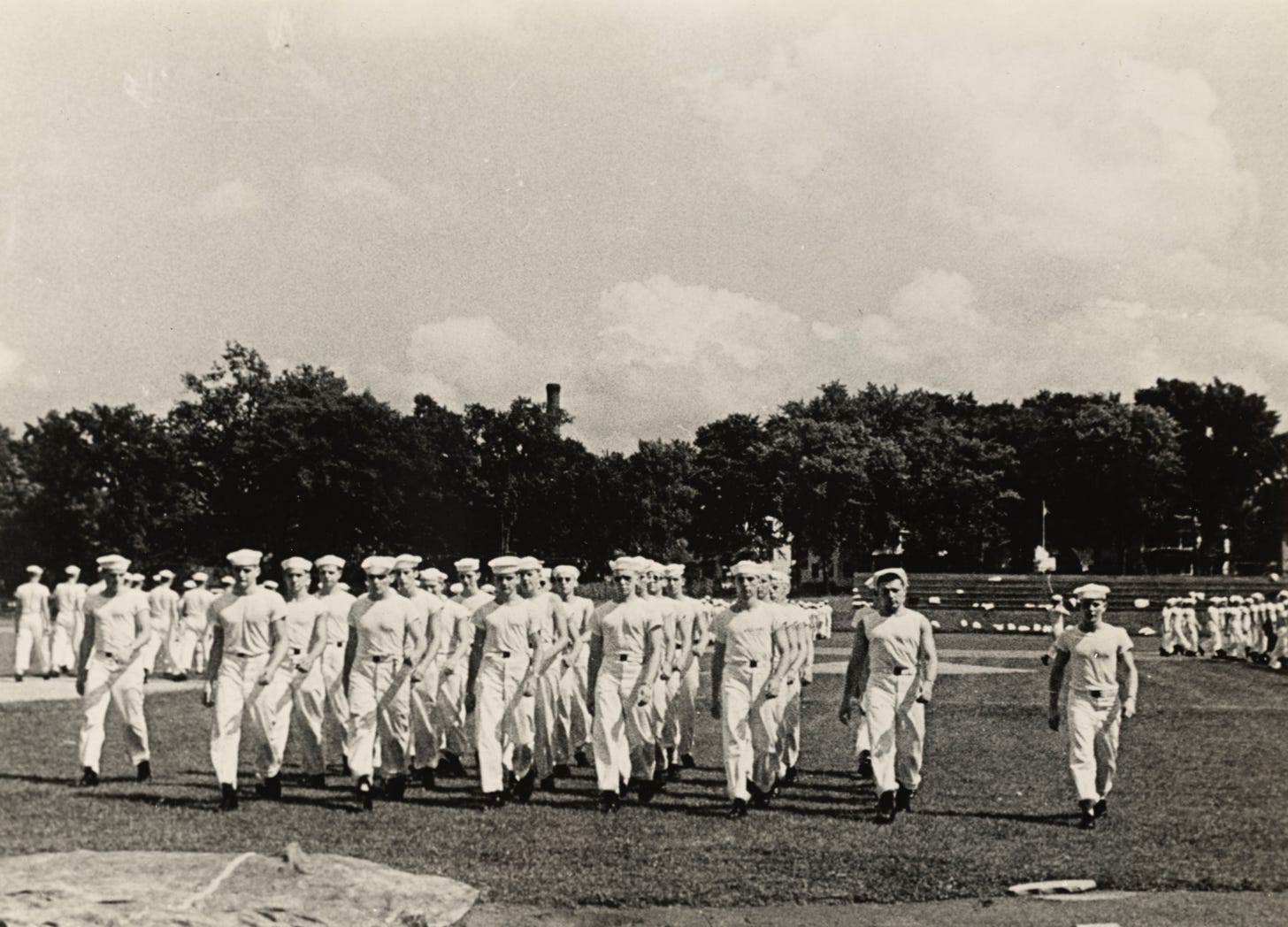
Nevertheless it took the war, the Army Specialized Training Program, and the Navy V-12 Program to bring the whole structure and objectives of liberal education under active reconsideration in most colleges. That part of the educational world primarily interested in the social sciences and the humanities was severely shocked by these programs.
Professors themselves had no difficulty in understanding why competent mature research men in chemistry, physics, and mathematics are especially useful in war. Victory or defeat may well be determined by the effectiveness of scientific research and its applications. Obviously, long training and experience are essential before men can do such research effectively.
It is quite another thing that the Services intent on the sole problem of winning the war — and to this end, in part at least, on selecting candidates with a capacity for leadership — required men to take almost exclusively subject matter customary in the early stages of engineering training and showed little or no interest in the rest of the liberal-arts curriculum.
Many observers question whether elementary scientific training carries men to the point where they can make effective use of the subject matter. They know that neither physics, chemistry, nor mathematics, to say nothing of thermodynamics or the theory of electricity, is understood by the multitude of American youths who not only operate but keep in condition automobiles and other mechanical devices.
They know that American industry utilizes a multitude of men who operate and maintain complex machines and control functions and processes in factories through scientific instruments. If the notion was that for all men the instruction must be immediately practical, I personally would see more reason for courses aimed to develop manual dexterity and skills in operating and maintaining complex machinery, that is, for ‘know how’ courses than I do for the basic requirement of elementary instruction in subjects like mathematics, physics, and chemistry.
In his critique of the two programs that sent servicemen to college during World War II, Dean Donham focused all of his attention on students engaged in ‘elementary scientific training’. In doing this, he neglected to mention the soldiers trying to master a foreign language, make sense of psychology, or learn veterinary science, sailors completing degrees in theology, or the participants in both programs attending medical or dental school.
This said, I do not doubt Donham’s report of the shock experienced by colleagues upon discovery that neither program provided students with opportunities to take courses in the humanities or the social sciences. Likewise, I sympathize with Donham’s opinion that men who had devoted a year to the art of ‘operating and maintaining complex machinery’ would have made greater contributions to the war effort than those who had spent the same amount of time completing the first half of an accelerated undergraduate degree. (According to the time-table used by the Army Specialized Training Program, a soldier completed a semester in thirteen weeks and a full academic year in twenty-six weeks.)
That said, Donham, who put his manuscript to bed after the Normandy landings of June of 1944, knew much more about the likely duration of World War II than the designers of either of the collegiate training programs. Indeed, in the fall of 1942, when these officers of the Navy and War Departments completed their designs, they expected that the conflict might continue though 1946 or 1947. Likewise, the architects of the Army Specialized Training Program did not know that most participants would spend less than a year on campus. (Early 1944, a military manpower crisis would cause the War Department to find new assignments for eighty percent of the hundred and fifty thousand soldiers then assigned to college campuses.)
Tragically, more than half of the men pulled out of the Army Specialized Training Program ended up as privates in combat units, where many found themselves in reporting to non-commissioned officers who struck George C. Marshall, then serving as chief of staff of the US Army, as ‘below satisfactory standards of intelligence and qualities of leadership’. With that in mind, I find myself thinking that, instead of sending them to college, the US Army would have been better off putting its clever young men in programs that combined service in operational units with intensive preparation for service as squad leaders, tank commanders, and forward observers.
The failure of the Army to do this owes much to a presumption already well established in many corners of American society in 1943, the notion that every young man with sufficient brain power to handle the academic challenges of tertiary schooling ought to spend the last season of his youth in a college or university.
Sources
Wallace Brett Donham Education for Responsible Living (Cambridge: Harvard University Press, 1944) (Internet Archive) page 11
Kent Roberts Greenfield, Bell I. Wiley, and William R. Keast Procurement and Training of Ground Combat Troops (Washington, DC: Center of Military History, 1991) pages 28-39 (Center of Military History)
Kent Roberts Greenfield, Robert R. Palmer, and Bell I. Wiley Organization of Ground Combat Troops (Washington, DC: Center of Military History, 1987) pages 192-193, 237-238, and 247-248 (Center of Military History)
Related Reading


