
Timbre
Pardon My French

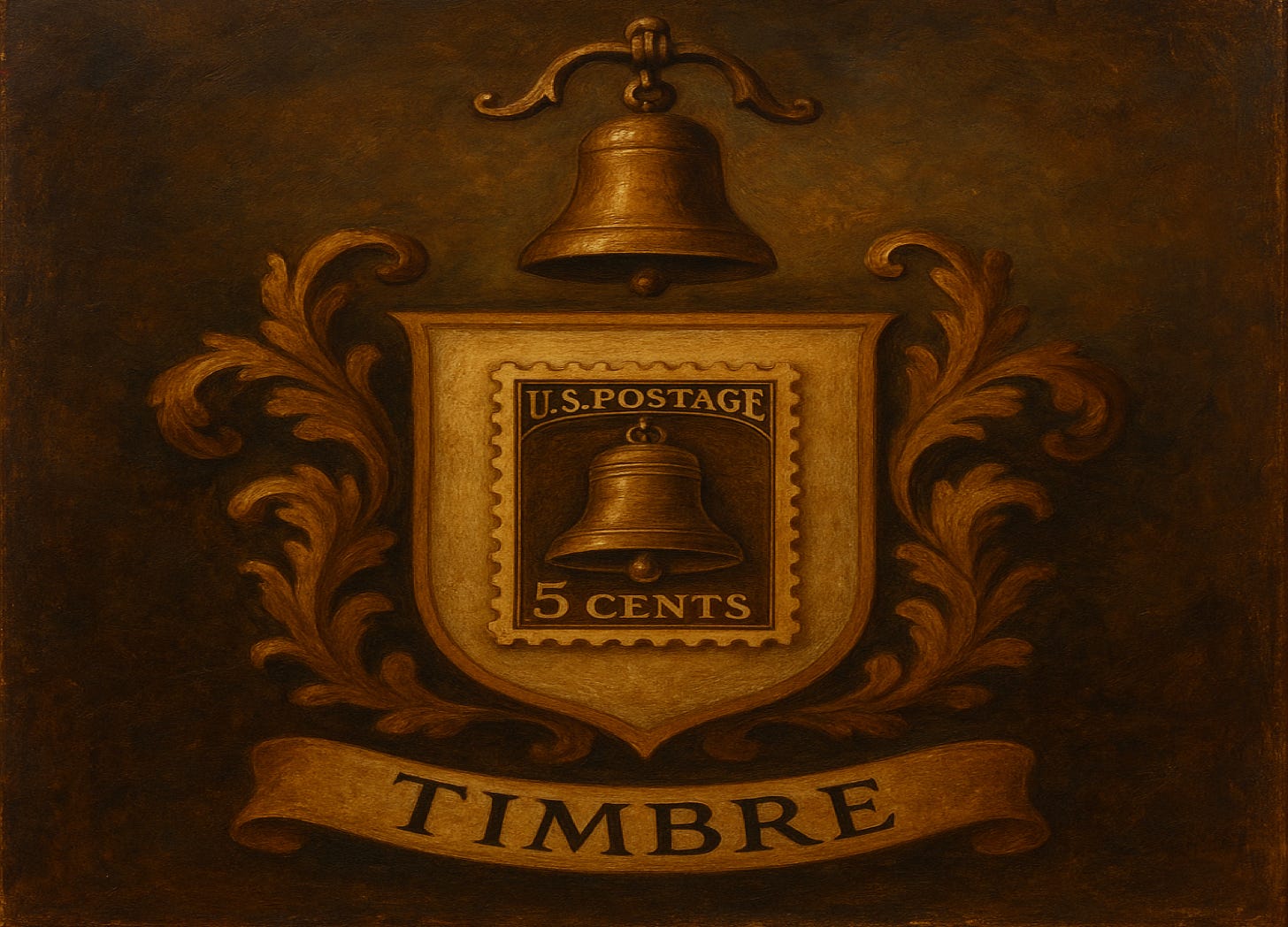
Over the course of the last millennium or so, the word timbre has played several roles in the French-speaking world. When knights were bold, it applied to both drums and bells. Later, when chivalry had become a game of dress-up, it provided a name for the decorations -whether helmets, crowns, or critters - that rested upon the shield at the center of a coat of arms. Finally, in the age of steamships and locomotives, it came to mean both stamp (whether sticky or impactful, postal or bureaucratic) and the emotional effect of a piece of music.
It was in this latter era, a time when the works of Charles Dickens were still being serialized in newspapers, that ‘timbre’ entered the English language. The word made its earliest appearances in books about singing. Within a few decades, however, teachers of elocution had begun to employ ‘timbre’ to describe that quality of a voice that both reflected the mood of the speaker and affected the feelings of his listeners. In the twentieth century, the word proved useful to teachers of living languages who wished to help their pupils approximate an authentic pronunciation of complete sentences in the target tongue.
On its journey from the world of music to the realm of prosaic speech, ‘timbre’ followed the trail blazed by ‘tone’. Thus, few expressed surprise when, from time to time, it broke free of its connection to sound, thereby becoming an understudy for such phrases as ‘general disposition’, ‘predominant mood’, and ‘overall appearance’. Indeed, the last time I encountered ‘timbre’ in the wild, in a characterization of a book that ‘captured the timbre of a vanished world’, it was serving that purpose.
The speaker who used ‘timbre’ on the aforementioned occasion, an Englishman speaking before an audience at a name-brand university, imitated the French pronunciation of the word. That is, he put a lot of stress on the first syllable (‘TAM’) but little on the second (‘bruh’). A romp through videos made by music teachers with North American accents, however, tells me that Anglophones in the Western Hemisphere prefer to pronounce ‘timbre’ in a way that rhymes with ‘amber’. Thus, to quote the immortal words of David Crowther, ‘you pays your money and you takes your choice’.
Sources
The illustration at the top of the page resulted from an experiment I ran on ChatGPT.
The examples of the use of ‘timbre’ in writing come from works I found by running key-word searches on the website of the Hathi Trust.
The sentence in which an Englishman pronounced ‘timbre’ as ‘TAM bruh’ appears, at minute mark 1:33, in the introduction to a lecture by Margaret MacMillan. (You Tube).
For Further Reading

