


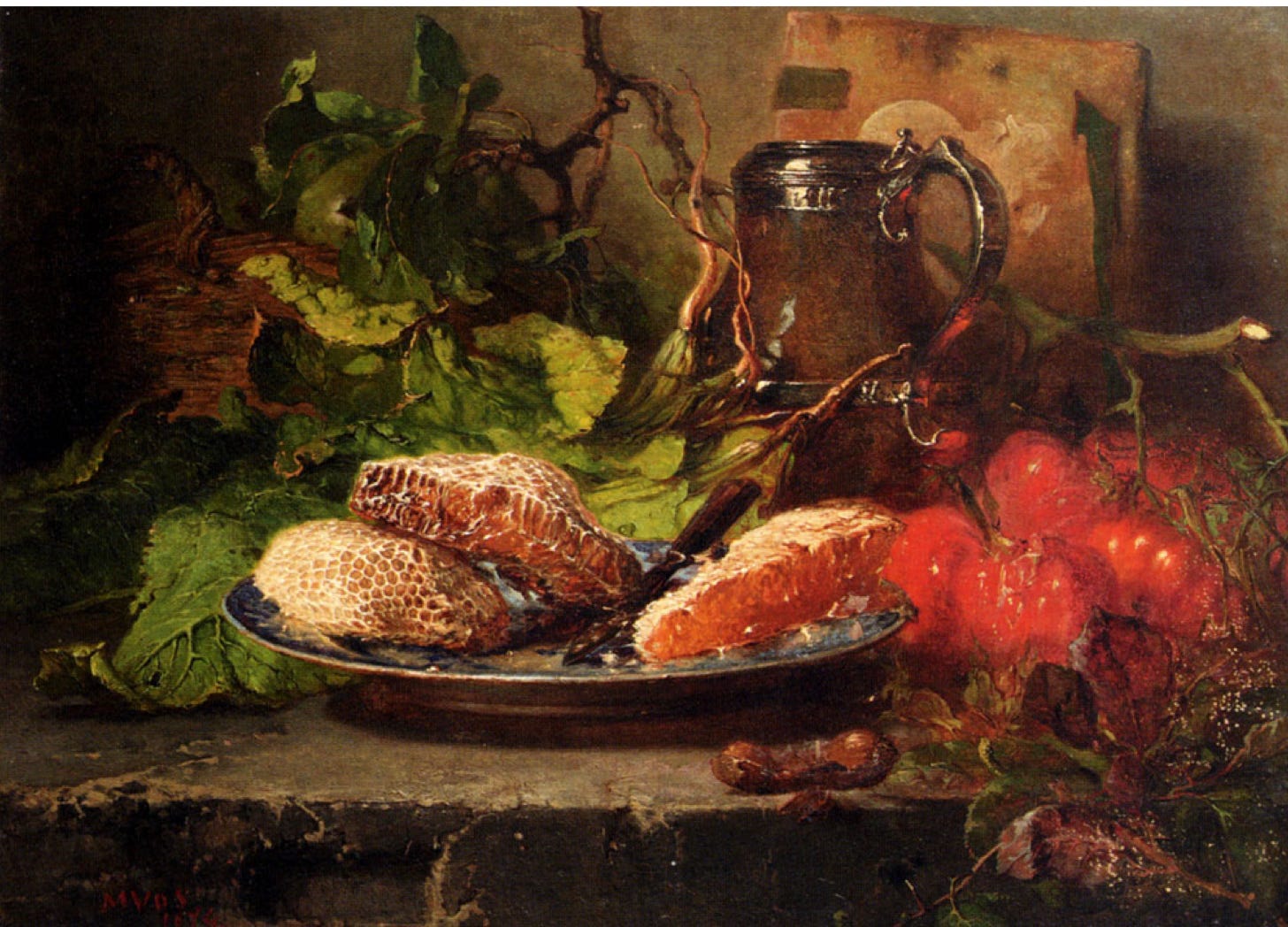
Sometimes the words you seek flow like honey in August. Sometimes they don’t.
When the latter state of affairs rears its treacly head, consider doing one or more of the following things.
Organize
Assemble sources. Make notes. Outline.
Make lists of words, phrases, metaphors, similes, and allusions that you would like to use.
Read Well-Written Words
Read poetry. Better yet, read it aloud. Best of all, recite a bit of verse you committed to memory years ago, when the world was young.
Please note that, when I refer to ‘poetry’, I’m talking about compositions rich in rhyme, alliteration, and, if it can be done without gymnastics, a Classical reference or two.
So, dive into the good stuff. Kipling, Tennyson, and Noyes come to mind.
Select Paintings
If you are writing for Substack, or a similar venue, you will want to put a nice illustration at the top of your piece. As a rule, a painting beats a photo. Within the realm of digital copies of color on canvas, moreover, works wrought in oils tend to trump watercolors.
The first stop on your search for paintings should probably be Art Renewal. If that fails, look up the collections for particular painters that abound on the Wikimedia Commons. (See, for example, this page, which offers lots of examples of the work of Franz von Defregger.)
You can steer clear of the rocks and shoals of copyright law by limiting yourself to pictures painted more than a century or so ago.
Do More Research
The failure of words to appear when bidden often results from a lack of things to say.
Make Maps, Diagrams, and Infographics
If you are writing about a place, make a map. If you are writing about an organization or process, make an organigram or infographic.


Once you have made this picture, writing a tale of location, relationships, or movement becomes much, much easier.
Change Genres
If you are writing a technical manual, express your instructions in verse. (The tunes and tropes of County music lend themselves well to descriptions of mechanical things, like trucks, trains, and line dancing.)
If you are writing a short story, write a Linked In profile for one of the characters.
If you are writing a learned treatise, reduce the essence of your argument to a limerick.
Take Care of Yourself
You know the drill. Eat well. Exercise. Get plenty of sleep. Keep company with the people you love.
Write an Article about Writers’ Block
Done … and dusted!
For Further Reading:


Make Maps, Diagrams, and Infographics
This is good advice. Try a run of Youtube shorts. Keeping on one topic for less than a minute it helps generate ideas.
First!
Anyway, on a more serious note, I often follow Greer's advice which is to never Write and Edit at the same time. Writing and editing use different parts of the brain, so trying to do both just clogs them both up.