


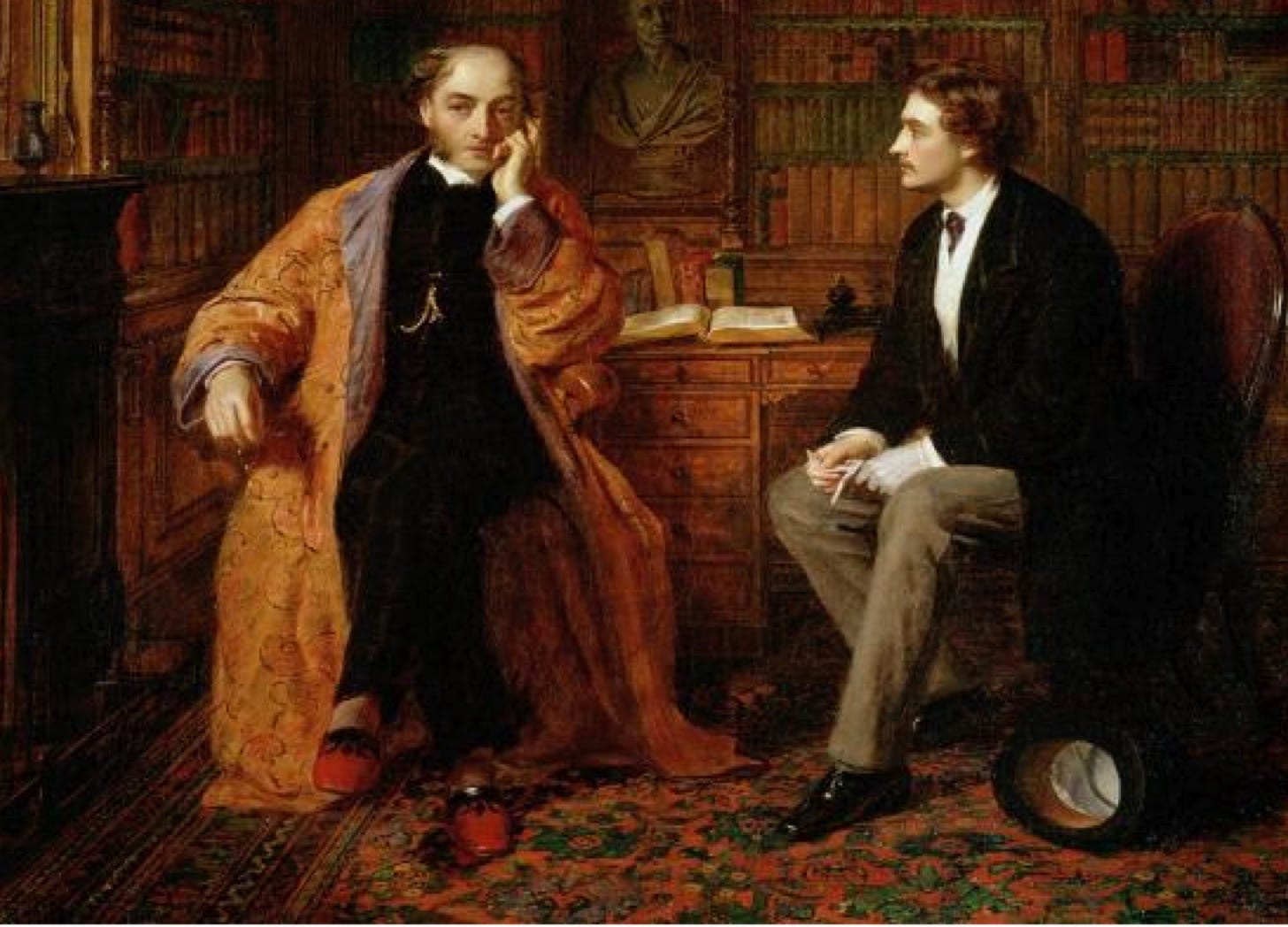
“Tutorials were normally run in pairs, but we had an odd number in our group, and, by remaining tactically silent during the selection process, I managed to become the only person who got solo tuition that term. And so, from January to March, over eight weeks, I was privileged to choose the authors I wanted to study and to get dedicated time to discussing them with an expert.”

                                                                                                                                 Henry Oliver
Marvelous to say, the undergraduate experience at the most prestigious universities in the English-speaking world bears considerable resemblance to the kind of extra muros learning celebrated in this blog. Rather than sitting in lectures in the hope of catching the nuggets of fact or fancy likely to appear on an idiosyncratic examination, undergraduates at Oxford and Cambridge write substantial essays, often on topics chosen by themselves. Instead of mining, highlighter in hand, additional nuggets from overpriced, committee-written textbooks, they engage the works of proper authors, often between covers that bear witness to many years of thoughtful reading.
Once a week, each student meets with his tutor. If said tutor has drunk deeply from the cup of the milk of human kindness, he offers his students some tea. On special occasions, he may provide a wee glass of sherry. (In the merry month of May, I would sometimes take my students out for ice cream. This, however, had more to do with the peculiar inclinations of an eccentric American than any time-honored tradition of England’s oldest university.)
However welcome they might be, comestibles play no essential role in such meetings, which, Oxonians call “tutorials” (whence the name of the system) and those who dwell on the banks of the Cam call, with suitably republican utility, “supervisions.” Rather, each such rendezvous customarily begins with the reading by a student, viva voce, of his most recent composition.
Luke Ranieri might characterize such a lecture (in the original sense of that word) as bonum in se. After all, reading a paper out loud will drive awkward phrases from their hiding places and make clichés stick out like sore thumbs. The definitive purpose of this exercise, however, lies less in the refinement of the rhetoric of the author than in the exploration of the logic of his argument and the setting of the stage for an open-ended conversation.
Needless to say, there are times when a tutorial session falls short of this Socratic ideal. The reading of papers can easily degenerate into a perfunctory performance and a dialogue degenerate into didactic digressions of various sorts. (The latter problem also plagues another of the Socratic teaching methods of my acquaintance, the version of the case method made famous by the Harvard Business School.)
That said, even when the tutor permits pro forma reading or fails in his duty to ask challenging questions, the work students do to prepare for tutorial sessions fosters habits conducive to lifelong learning. These include the simultaneous entertainment of opposing opinions, the use of such beliefs to cast light upon their competitors, and the description of such thoughts in clear, but nuanced, language. To put things another way, while students can learn much during (and from the reflection that follows) well-run tutorial sessions, the chief benefit of the tutorial system is the work done before such meetings.
Because of this, an ambitious autodidact can replicate the experience of preparing for an Oxbridge tutorial by writing an essay. This disquisition, which will probably weigh in a some 1,500 words, should attempt to provide a thorough (but far from exhaustive) answer to an open-ended question related to a well-covered field of study.
Consider, if you will, the question of the degree to which Henry VIII embraced the Protestant Reformation. A quick search of the Mother of All Library Catalogs on the keywords “Henry VIII” and “Reformation” will uncover four thousand or so books that, to some degree or another, touch upon this matter. A similar search on the Internet Archive will reveal a less daunting number of books that focus on the question. (Twenty or so of these were published before 1927, and, as such, can be downloaded for free. A dozen or so emerged from the press since the debut of talking films, and thus must either be read on line, or found elsewhere.)
A visit to a highbrow bookshop or a well-stocked public library will allow the autodidact to add more recent works to his list. These will be written in up-to-date language, richer in references to contemporary culture, and less dependent upon the commonplace knowledge of yesteryear. At the same time, they will, for the most part, describe the same events as works written in the days of corsets, cravats, and crinolines, and make many, if not most, of the arguments put forth by their straight-pen wielding predecessors.1
While you are going through this treasure trove of printed matter, you may want to use some of many readily-available video programs about Henry VIII (and, especially, his love life) to provide some context, color, and human interest to your search. (The list of own favorites includes the classic film Anne of a Thousand Days, the television series Wolf Hall, and the documentaries of David Starkey.) Such resources, however, cut both ways. Thus, you will often have to remind yourself that there was more to sixteenth-century England than lutes, flutes, and daring décolletage.
For Further Reading:

If, after reading my paean to Victorian historians, you persist in wishing to read hot-off-the-press discussions of the events of half-a-millennium ago, you will save yourself a little time, some trouble, and considerable treasure by making use of the many recently submitted doctoral dissertations that can downloaded, gratis, from university websites.
Indeed, an essay in every pot! What a great idea. Much better than pontificating in online forums such as this. At least the essay forms the research and thoughts into one place.