


In the summer of 2011, while searching for good descriptions of the Socratic method, I ran across the following passage from the Autobiography of Benjamin Franklin.
While I was intent on improving my language, I met with an English grammar (I think it was Greenwood's), at the end of which there were two little sketches of the arts of rhetoric and logic, the latter finishing with a specimen of a dispute in the Socratic method; and soon after I procured Xenophon's Memorable Things of Socrates, wherein there are many instances of the same method. I was charmed with it, adopted it, dropped my abrupt contradiction and positive argumentation, and put on the humble inquirer. 1 2
After telling this story, Franklin proceeds to describe the ways that he used the Socratic method to defuse the arguments of people who were trying to impose their opinions upon him. However, as this story appears in a section of the autobiography that deals with Franklin’s efforts to educate himself, I suspect that “putting on the humble inquirer” also helped him engage, with an open mind, the many new ideas he found between the covers of books.
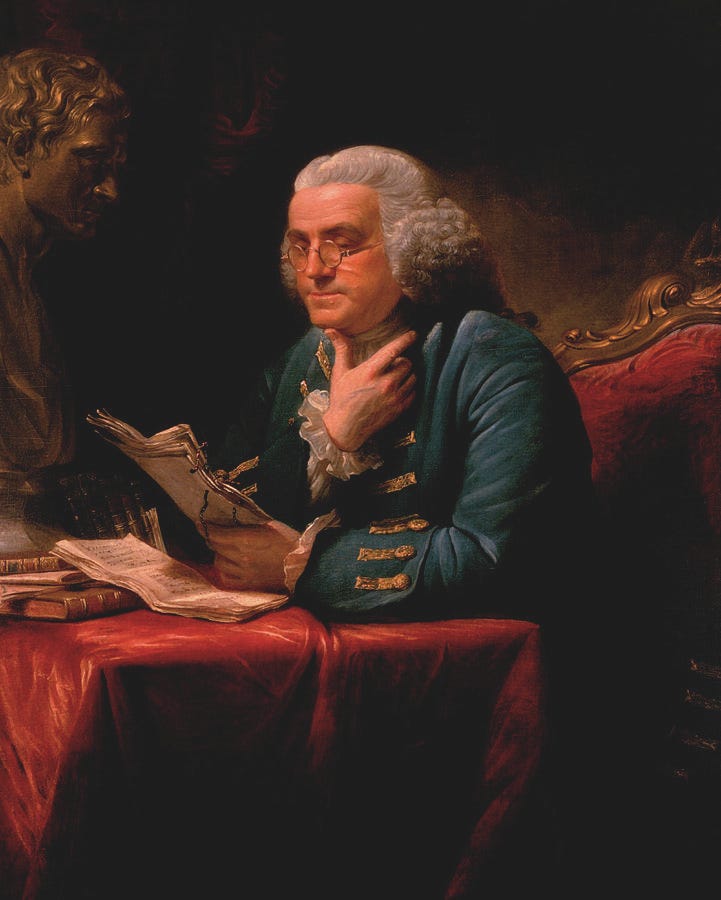
Dr. Franklin seems to have used the translation of The Memorable Things of Socrates made by Sir Edward Bysshe (Dublin: George Faulkner, 1757).
The more I learn about Franklin, the more I realize that he was simply head and shoulders above almost everyone else in terms of intellect and wisdom. His capacity to learn is off the charts, and his curiosity remains an inspiration to me today.
The beauty of Socratic method is that it lets people of goodwill search for the truth of the matter, together, by methodically stripping away that which cannot stand up to critical scrutiny and analysis. It nurtures curiosity and mutual understanding, rather than allowing the matter under discussion to devolve into a morass in which each party NEED the other party to be "wrong" because they each NEED to be "right."
What is needed are deeper and deeper levels of *understanding.*